.jpeg)

The Contradictions in India's pursuit for "clean energy"
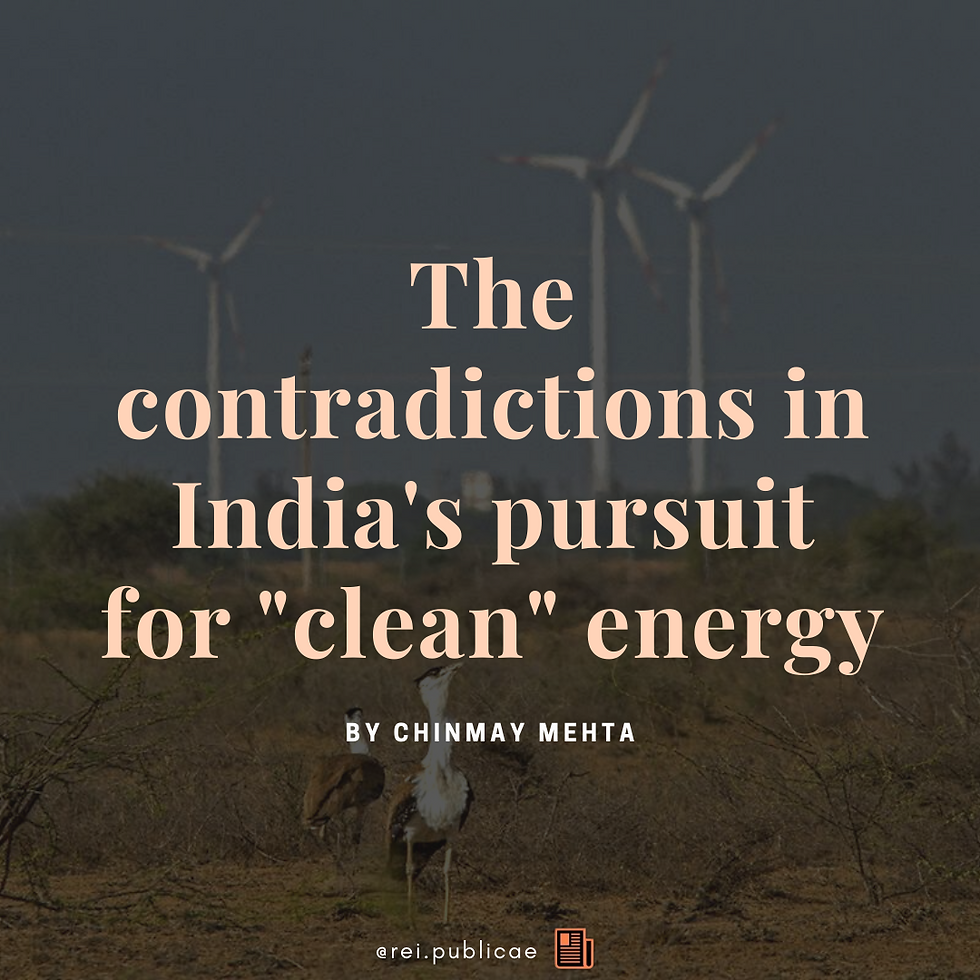
India is the world's third-biggest emitter of greenhouse gases. It is planning to move towards its aim to cut the projected emissions by a billion tonnes by 2030 and raise renewable power generation to 450 GW (equivalent to half the energy produced in the country). While doing so, there may be some contradictions with the way in which India is approaching this goal.
The government has launched multiple million-dollar projects aimed towards this goal and towards a more sustainable and eco-friendly future. But, did they take into account the multiple hurdles and the negative impact that these might pose?
Firstly, is India's power grip powerful and stable enough to handle the inflow of renewable power from hydel, solar and wind plants? The simple answer is no, they are not. There will be a considerable increase in Renewable Energy (RE) power. A lot of what is generated is variable depending upon the weather conditions. Due to this, the supply for RE is never stable. This makes operating the power transmission grid a technically demanding task. Until recently, Renewable power capacity was small, but now RE projects are producing so much power that they are sometimes required to reduce or switch off generation to ensure that the grid is operating smoothly. What can be done to make them more powerful and stable?
Firstly, decentralisation of power grids. Setting up smaller plants and grids in localised areas instead of large grids in centralised areas should be the way forward. This will reduce the load on the single grid present in a cluster of multiple districts and cities. Providing incentives for power grid owners from the government to help them upgrade their grids and also keep them stable throughout is another important step that needs to be taken.
More recently, India has produced more power than it consumes. This is largely due to overbuilding of coal capacity in the last decade. The same logic can be applied to Renewable Energy. Distribution companies have therefore refused to sign new agreements to purchase the renewable power that is likely to come onboard as newer projects begin operations. Judicious and efficient allocation of RE power generated is important. Failing to do so might lead to wastage of power generated.
Secondly, is the land that is going to be used for setting up solar energy plants and wind energy plants, going to impact the wildlife and ecology of the region?
Some "renewable" energy modes also come with attendant environmental and social costs if poorly planned. This has already been witnessed with windmills and small-hydel plants in the Western Ghats. Let us look at how land allocation for solar and wind energy plants in India can hamper wildlife even more.
The grasslands of Thar and Kutch have been widely allocated for solar and wind expansion due to the unavailability of a national policy recognising them as important ecosystems. It is undoubtedly crucial to expanding our capacity for renewable energy. But the impact of this expansion on the unique and threatened biodiversity of Thar and Kutch needs serious consideration. The Thar and Kutch desert house a variety of ecosystems – from mangroves, saltpans and lagoons, to grasslands and dunes - but are often perceived as barren, lifeless places, where extreme temperatures make life difficult. And yet, a diversity of unique wildlife survives here, each species perfectly adapted to living in these regions. Yet, these lands have been, without a glimpse of consideration, allocated for renewable energy production. One can only imagine the negative impact of this on the region's already declining ecology.
Another question arises here. Why is the government not focusing on rooftop models of Solar power, which are successfully being implemented in Germany too? And why is it allocating hectares upon hectares of biodiverse areas for "clean and sustainable" energy production? Therein lies the big contradiction. It is negatively impacting biodiversity in hopes of positively impacting our future. Damaging the ecology to produce "clean energy" does not seem like a good bargain.
Moreover, the 'anti-eco friendly' production of 'eco-friendly' solar energy needs to be highlighted. The PV cell (used in solar grids) manufacturing process includes hazardous chemicals such as 1-1-1 Trichloroethene, HCL etc. Workers face risks resulting from inhaling silicon dust. The manufacturing wastes are not disposed of properly. Proper precautions during usage of thin-film PV cells, which contain cadmium—telluride and other harmful chemicals are missing. These materials create severe public health threats and environmental threats.
Conclusion
Thus far, it’s fossil fuel companies that have had the worst environmental records — not just in terms of pollution but also land grabs and violation of human rights. Renewable energy companies and projects have promoted themselves as the ‘noble and clean’ alternatives, providing clean energy, free from carbon emissions. As India turns to such projects on a large scale, one must remember that while they may be portrayed as "clean", they still have an ecological footprint. And if they want to retain their ‘"clean" image, they have to control their environmental impact.



Comments