.jpeg)

The Never Ending Armenia Azerbaijan Conflict
- Ali Malik
- Oct 20, 2020
- 4 min read
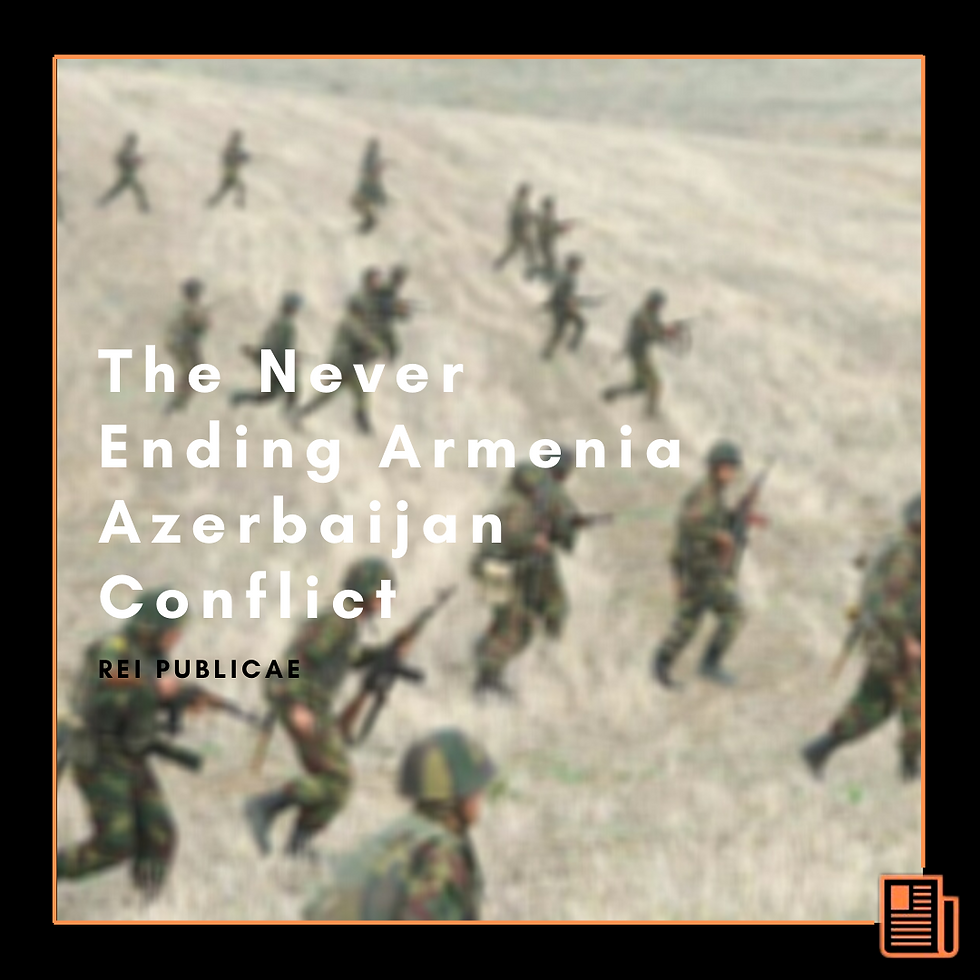
The worst violence in decades over Nagorno-Karabakh is in its fourth week with no sign of easing, amid reports of intense fighting close to Azerbaijan’s border with Iran. But what are the reasons for this dispute of the Nagorno-Karabakh region? The region, having 95% of the population as ethnically Armenian and also controlled by them, is internationally recognised as part of Azerbaijan.

The history of the Karabakh region before the Russian period is the subject of conflicting nationalist interpretations. In 1805, Russia captured the territory, and, in 1828, the Tsar created an Armenian province excluding Karabakh. The Bolshevik Revolution of 1917 provoked ethnic violence. Armenia and Azerbaijan both claimed Karabakh when they became independent in 1918. The Soviets established dominion over the two republics in 1920; each then expelled many rival nationals. Karabakh was ceded briefly to Armenia. According to Armenians, in July 1921, the Transcaucasia politburo voted to join Karabakh to Armenia. Stalin disagreed, he said, to advance peace between Armenians and Muslims and acknowledge Karabakh’s economic tie to Azerbaijan, and reportedly to please Turkey. In 1923, the region became the Nagorno Karabakh Autonomous Oblast, part of Azerbaijan with a degree of self-rule. The 1936 Soviet Constitution continued the designation. In 1985, Soviet President Gorbachev’s policy of glasnost or openness unleashed long-suppressed hostility between Armenia and Azerbaijan. In 1987, Armenians in Karabakh petitioned the Soviet government to transfer the region to Armenia. Azeris who claimed they were evicted from Karabakh demonstrated in early 1988; several were killed. Azeris in Karabakh boycotted local elections and referenda. In February 1988, Karabakh called on the Armenian and Azerbaijani Supreme Soviets (parliaments) to approve the transfer. Anti-Armenian violence erupted in Azeri cities. Before the conflict, about 140,000 Armenians Armenia and Azerbaijan and 48,000 Azeris inhabited Karabakh. Armenians have since fled or were driven from Azerbaijan and Azeris fled or were driven from Armenia and Karabakh, as well as from Azeri regions around Karabakh. Karabakh seceded from Azerbaijan on July 12, 1988. Azerbaijan declared the act illegal according to the Soviet Union’s Constitution, which stated that the borders of a republic could not be changed without its consent. Moscow imposed martial law on some areas in September and deployed Interior Ministry troops in November and army troops in May 1989. On December 1, 1989, the Armenian Supreme Soviet declared Karabakh a part of Armenia. Armenians took control of Nagorno-Karabakh and seven surrounding districts of Azerbaijan in a 1990s war amid the collapse of the Soviet Union. Azerbaijan says it’s fighting to recover its internationally-recognized territory, while Armenia says it’s defending Nagorno-Karabakh’s right to self-determination.
On 5th October, Armenia accused Azerbaijan of firing missiles into the capital of the Nagorno-Karabakh region, while Azerbaijan said several of its towns were attacked and its second-largest city, Ganja, was “under fire”. Nagorno-Karabakh has once again become the site of air and artillery attacks between Armenia and Azerbaijan. Clashes between the two countries erupted on 27 September for the first time in almost 30 years after which Armenia declared martial law and ordered the total mobilisation of its military. It claimed to have shot down several Azerbaijani aircraft and tanks and accused its neighbour of attacking civilian settlements in Nagorno-Karabakh’s regional capital, Stepanakert. Meanwhile, Azerbaijan said it counter-attacked Armenian shelling. Both countries continue to point fingers at each other for violating ceasefire while clashes have so far killed an estimated 250 people, including many women and children.
The conflict prompted Iran, an immediate neighbour of both countries, to contemplate a peace plan. The hostilities hold larger geopolitical implications as Turkey, under President Erdogan, is backing Azerbaijan and has been accused of sending in Syrian troops but Turkey has said it hasn’t offered anything other than “training, weapons sales, and political support to Azerbaijan”. Meanwhile, Russia, which enjoys good ties with both countries, has called for a ceasefire.
So far, the main driver of diplomacy between the ex-Soviet enemies has been Russia. Russia has struggled to rein in the fighting in an area it views as its sphere of influence, partly because of Turkey’s active support of Azerbaijan’s military campaign. The failure to stop the fighting has raised fears of a humanitarian crisis, and put new strains on ties between Turkey, which strongly backs Azerbaijan, and its NATO allies which want the conflict to end.
NATO member-state Turkey was the first nation to recognise Azerbaijan’s independence in 1991 and has long supported it in the Nagorno-Karabakh conflict. However, current Turkish President Erdogan has been accused of ramping up his country’s intervention in support of its “fellow Turkic-speaking Azerbaijan”. Armenian officials recently alleged that Turkey has been sending fighters from Syria to the region. Turkey, meanwhile, lacks any official relations with Armenia and had shut its border with the country in the run-up to the 1994 separatist war.
Russia has enjoyed strong relations with both countries and has been supplying arms to both sides. However, after the recent clashes in Nagorno-Karabakh broke out, Kremlin has made conversations with the Armenian Prime Minister NikolPashinyan, but none with Erdogan or Azerbaijan’s President Ilham Aliyev.
All are concerned over this situation which threatens and not only affects regional but international peace and security. Hence, there is a need for both of the sides to cease hostilities immediately, keep restraint, and take all possible steps to maintain peace at the border is paramount because with the current situation worsening and nations involving directly in the conflict we can only be optimistic and hope things reach a lasting resolution only through peaceful diplomatic negotiations.



Comments