.jpeg)

The Unexpressed Side of the Education System
- Arya Lamba
- Oct 10, 2020
- 5 min read
OPINION
The first feeling that comes to us when we think about the education system (in our case it's CBSE) is that of hatred or anger. The obsolete and unnecessary syllabus; The time commitment required; The constant pressure: It is all just too much for us to handle. Have you ever thought why are we doing all this?
1.To get into college?
2.To learn?
3.To Develop basic mental abilities?
All of these arguments that can be considered, but are not sufficient enough to justify the time, effort, and money every single student is spending on this redundant “education”. We have 1000’s of pages of the syllabus, 4 major exams in a year, entrance exams, practical exams, VIVAs, and much more. The system is based in a way that whatever we learn in school, we have to repeat the same in tuition and then at home. On average, a normal student might study for 6-8 hours a day during "exam-times" if not daily (including school and tuition).
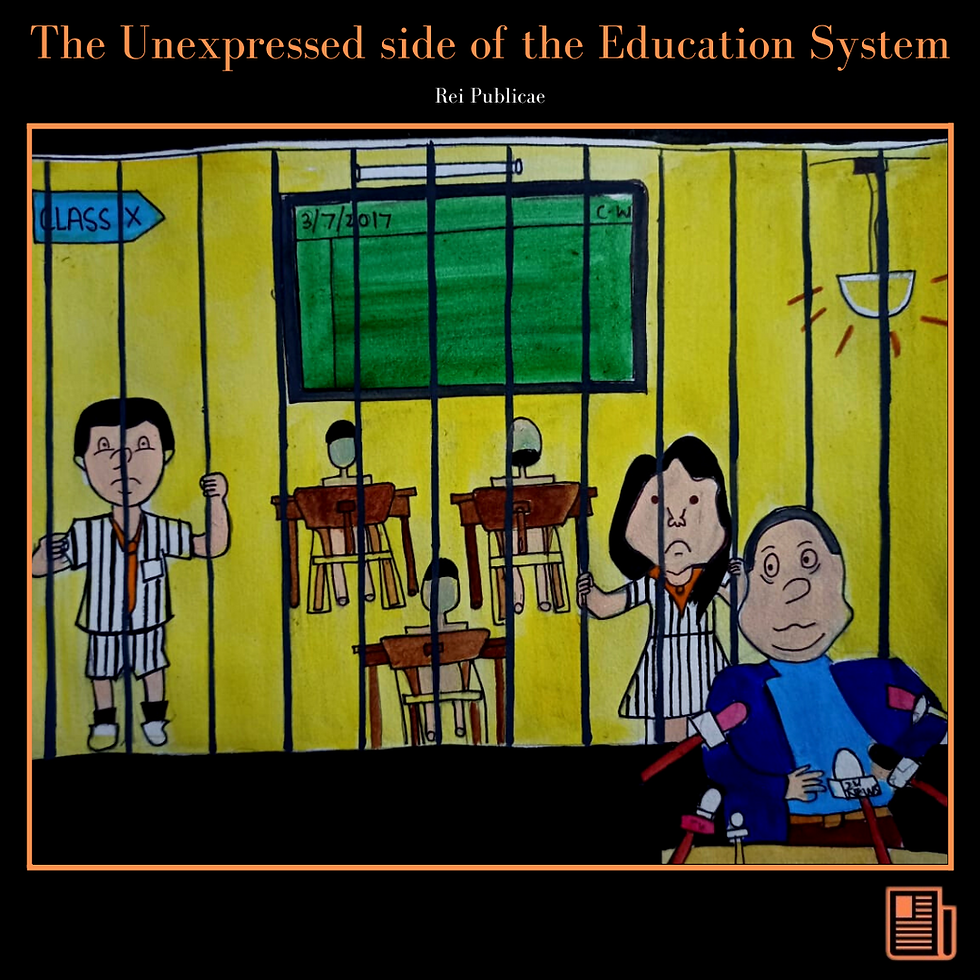
The reason for all this, although simple, can be a quite shocking one. A theory proposed is that the whole system that we call "education" might just be another conspiracy by the government: by burdening every single student they are preventing the masses from thinking or actually learning anything productive. If the youth doesn’t have time to think, the important questions and problems around them are completely ignored. The abject poverty, the environmental calamities, the crime, the political rubbish is just turned a blind eye towards. Whenever we ask our parents to go for a protest they generally refuse, not for the reason that it's unsafe or risky but for the sole reason that our time would be "wasted" and I should focus on studies. The same will be applicable for, not thousands, but lakhs of students.
Now some might argue that the adults can still protest and “when time is right the youth can start”, but what we fail to understand is after a certain age the idealism and the optimism in adults dies, Adults usually have the responsibility for themselves and their families. Moreover, as time passes we are convinced that nothing will change, so we stop trying as seen in the case when we try to change a very stubborn person's opinion. The Youth, on the other hand, has power because they have nothing to lose, minimal responsibilities, and hence minimal risks.
All that we have said is not true just for India, but for countries all over the world. Take for example Greta Thunberg, a young environmental activist who was heavily criticised not for what she does but because of her disabilities by none other than the president of the United States of America. if the young girl is so irrelevant, so incompetent, then why did the president of the most powerful country in the world personally attack her?
In simple words, she is just a young girl who is making change and encouraging other youth to do the same and this makes the current leaders insecure.
Even if what I’m saying from a political stance is “wrong”, let us view it from a philosophical angle. We are all studying today for something in the future. School ends, college starts, then post-graduation, then work, and then we pass from this earth. We die, but the superficial aspirations that the system has created in us are eternal.
“We all live in the hopes of future glory and then we die” - Arya Lamba
In the process of attaining glory, we forget about the present. The present Is all that matters; its all that we have. We’re working to be something we ‘might become’ in the future, that might never even exist. The system is creating the ‘illusion of control’. We feel that if we do for example an ‘MBA’ we are sorted, or for an actor, the same might stand true for an award. But we don’t account for “life” for “fate” or for accidents that could occur. The only thing we have control over is our mind, our actions, and our thoughts and when we realize this we will truly be enlightened.
“Life is what happens while you are busy making other plans” – John Lennon
The Basic Idea of Education in India and the notion of "failure"
The education system that exists in India has not been a subject to much change since its formalisation in 1964-66 by the Education Commission. The idea since then has been the pattern of 10+2. In this pattern, the first 10 years is subdivided into 4 years of primary education, 6 years of High School followed by 2 years of Junior colleges. However, the system might be changed with the proposed National Education Policy by the Indian Government. In a country such as India with a population of 135.26 crores(2018), there is a limited number of opportunities everywhere.
Being the second-largest country by population, India was reported at 20.69 % in 2020, according to the World Bank collection of development indicators, compiled from officially recognized sources in the employment to population Ratio. This leads to an inevitable competition. On top of that many parents put tremendous pressure onto their own kids for performance. Due to this, it was once found in a study in the American Psychological Association's (APA) Journal of Personality and Social Psychology that an average teen reports more anxiety than a mental asylum patient of the 1950s. Every mind is different, thus not all minds perform every activity in the same manner. Now a student may be arithmetically retarded, or slow. What does society do to such a student?
Now we must understand that basic arithmetic practice is necessary to improve cognitive skills, however, why must such a student be forced to get a certain degree of marks otherwise they can not be promoted. It destroys the child's self-confidence when they see the same task being performed effortlessly by their peers. What is perhaps required is the practice but not the pressure that even if they do not perform well, they may not be called a failure. Traditionally there are some occupations that are more respected in India, and the idea of the same is drilled into the minds of the younger generation which when later pursued, makes them confused and helpless. Among students, India has an average of 28 suicides reported every day according to the NCRB. The pressure they feel and the confusion due to lack of self-development pushes them to such a stage where they give up.
Conclusion
Altogether, what we intend to project through the data and the theory presented above is that regardless of the so-called "benefits" of our education system, it's still a long way from making the students content and satisfied with what they are studying. It's still a long way from not letting any student turn into someone that might cause harm to others. It's still a long way from making each and every person realise that education is not just a skill but a necessity. In our country alone, the dropout rates are among the highest in the world, leading us to the conclusion that its still a long way from the actual task of education i.e. harbinging the true potential of each child.



Comments