.jpeg)

The Unheard Role of the Indian Cabinet in the 1992 Scam
Till now, for most people, the 1992 scam could be explained in a couple of lines — Harshad Mehta took money from banks, played the stock market, and then could not return the money when the stock market crashed. Regardless of all the theories, the central figure of the scam remains Harshad, 1992 securities scam being referred to as the Harshad Mehta scam, which would be either giving him too much credit or making him the scapegoat, depending on how you look at it.
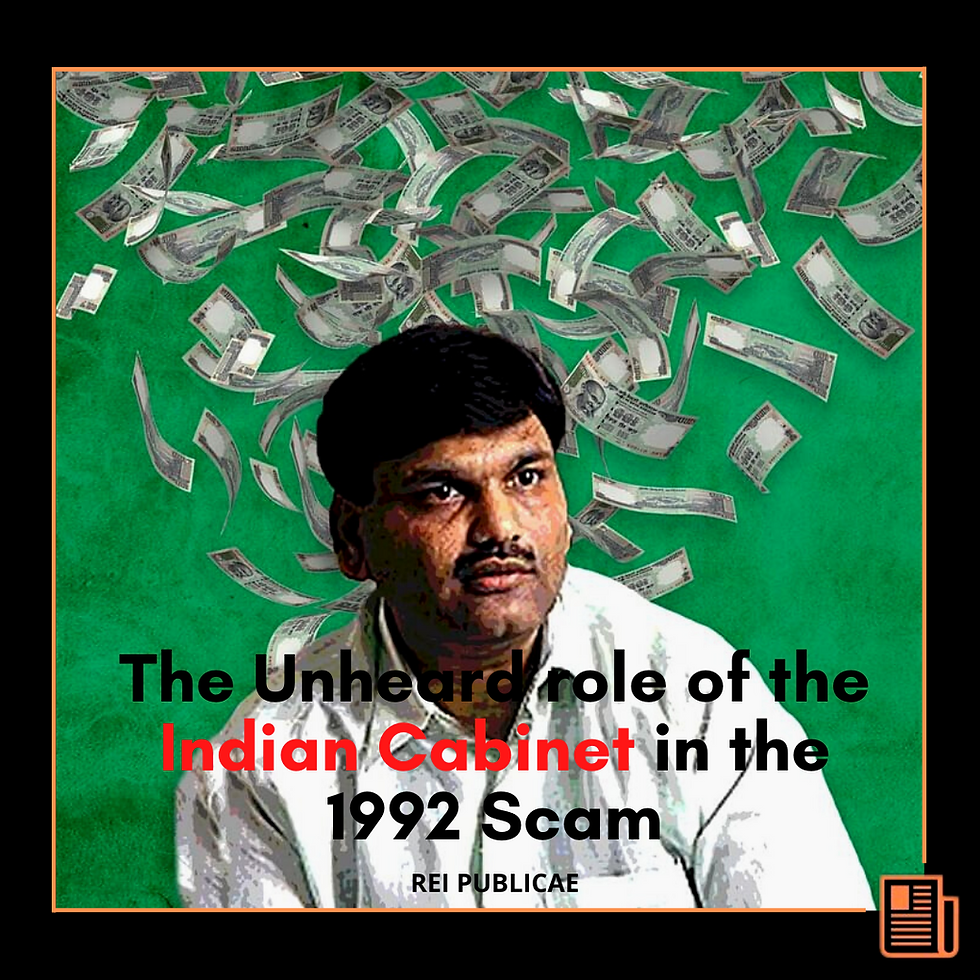
What did Harshat Mehta do?
Harshad came up with the replacement cost theory, whereby the stock of a manufacturing company should be valued at what it would cost to set up a similar plant. This theory found many takers and sent shares of even the most dubious companies soaring to exorbitant levels or as it is commonly called "being the bull of the stock market". The replacement cost theory was not an original one, except that he managed to sell it well. During the debate on the Securities Contracts Regulations Bill in 1956, Lok Sabha MP PD Himatsingka, did not agree with this, countering this theory by blaming manipulation as the sole reason for the rise in the price of any stock. For example, let's take Indian Iron and Steel Corporation (IISC), which was set up at an initial cost of Rs 5.2 crore. If the cost of an IISC share had risen to Rs 36 from the issue price of Rs 10, the cost of setting up a new steel plant would have had increased 20 times to Rs 100 crore. Even if all the outstanding shares were bought at Rs 36, it would only cost Rs 18 crore to gain control of a steel plant worth Rs 100 crore.
The Support of the Institutions
Harshad managed to convince financial institutions to buy the stocks he was bullish on. He may have had some good ideas, but it can’t be denied that the institutions’ support for Harshad also had to do with his clout in the corridors of power in Delhi and the quest for quick profits, rather than their belief in his stock-picking skills.
A good deal of Allegations
After having spent time in jail and been hauled over the coals by almost every government agency, anybody would have sued for peace with authorities or kept a low profile at the very least. Not Harshad. He accused the then Prime Minister Narasimha Rao of having accepted Rs 1 crore from him in return for political favours. Narsimha Rao denied that they met exclusively. But did they meet? This is a question that can be answered while looking at the facts present before us. An old India Today article notes that the rendezvous did take place, if not on Nov 4, 1991 as claimed by Harshad. It states: “There seems little doubt that he did - at some stage if not on November 4, 1991, as he states - meet Rao at Race Course Road. In fact, Rao has not so far denied having ever met the broker. Moreover, the Harshad camp has dropped broad hints that it is in possession of 'clinching evidence' to prove the allegations." It also notes that Harshad did arrange money and was in Delhi on the fated day. It was the first time anyone had claimed to pay the PM of the country a bribe.
Since then, political circles have been abuzz with rumours of the involvement of at least three Union ministers. George Fernandes, a trade unionist, even claimed in Parliament that four ministers were involved in the scam. Inevitably, Defence Minister Sharad Pawar figured prominently due to his links with Bombay's financial high-flyers. The CBI, rumours went, was instructed to nail Pawar so the prime minister could have one rival less. Top-level CBI sources say, a day after Fernandes' allegations, Rao asked the CBI to report to him personally if any of his ministerial colleagues were found involved.
The "no-result" Joint Parliamentary Committee
Another fascinating aspect was that of the Joint Parliamentary Committee (JPC) set up after the scam. The JPC was headed by congress veteran Ram Nivas Mirdha while also including the best Parliamentarians of the time - Jaswant Singh, Yashwant Singha, etc. The JPCs at that time didn't brief the media as the set practise. However, this JPC was an exception which unanimously briefed the media after every meeting. The same called all-powerful biggies, regulators, and probe agencies as witnesses. Many hoped that the probe would not only unearth the scam but also hunt down all ill-gotten wealth and put wrongdoers behind the bar. The whole system will be cleansed. Some did go to jail, they were released on bail, while some who should have, never got caught. Despite intense probes, like every other, this too finally met the same fate. Dashing all hopes of true and speedy justice, the final report made all the right noises but concluded that it was just a "systemic failure" which needed to be fixed.
The curious case of Manmohan Singh
Prime Minister Narasimha Rao, just after the scam was unveiled, asked finance minister Manmohan Singh to “finish the unfinished task” when the latter had resigned in wake of the securities scam involving Harshad Mehta. “I sent him (the PM) my letter of resignation… after seven days he wrote a very nice letter to me saying `you have to go back to your job and finish the unfinished task," Manmohan Singh said in an interview. He also said that “The committee did not find anything wrong in my conduct…They picked on a remark I had made in a Parliamentary debate. I had remarked in Parliament that every time the stock market sneezes, I cannot lose my sleep,” he said. “But I felt that since the committee had found some fault in me, I should resign and I sent my letter of resignation to Narsimha Rao ji.” What was this 'unfinished task' is a question that still rings in each journalists' mind.
What if...
One can’t help but wonder what course India’s financial history would have taken had news of Harshad’s problems not become public, had the stock market not been shut because of a strike, and had Harshad somehow repaid the money he had borrowed from National Housing Bank? But a temporary reprieve for Harshad would have certainly spelled ruin and a one-way ticket out of Dalal Street for some members of the bear cartel, the ones that pushed the prices of shares down. Maybe India would have had one less retail chain, and the stock market, a different Big Bull today.


Comments