.jpeg)

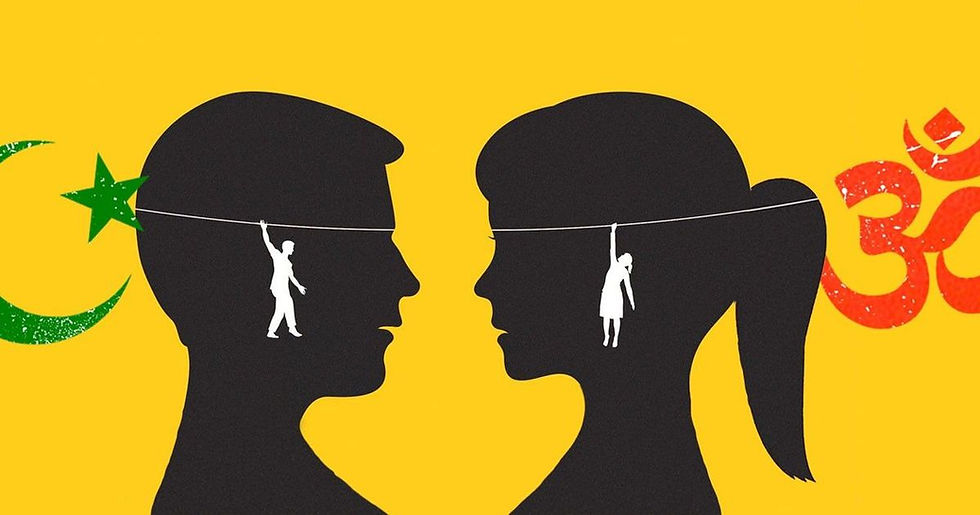
Will the newly established “love-jihad” law uphold religious equality?
Background Under the new Freedom of Religion Bill 2020, forced conversion of a minor, woman, or a person from Scheduled Caste or Scheduled Tribe, would draw a minimum jail term of 2-10 years with a minimum penalty of Rs 50,000 or similar penalties have been enforced in various states of India.

Government Side
Intention Behind the Bill
Such a bill was brought about in light of incidents where minor girls were converted, married & made to contest Panchayat polls. According to the United States Commission on International Religious Freedom (USCIRF) reports of 2016 and 2018, observers have noted that there are very few arrests or prosecutions under these laws but they “create a hostile, and on occasion violent, environment for religious minority communities because they do not require any evidence to support accusations of wrongdoing”. More recent reports by USCIRF have highlighted certain incidents of arrests, including an incident in 2017, where religious minority leaders and adherents faced intimidation and arrest as a result of these laws.

For example, a Catholic nun, along with four tribal women, was detained in June 2017 based on suspicion of induced conversion. In April 2017, three Christians were arrested in the Khandwa district of Madhya Pradesh following allegations that they were converting people.
In July 2017, Christians protested in Ludhiana, Punjab, after Sultan Masih, the pastor of the Temple of God Church, was murdered in public over suspicion that he could be engaged in conversion.
Why is this law needed?
The need for such a law is long-awaited, the central government time and again has given the opinion that a law against forced and fraudulent conversions could not be created at a national level since law-and-order is a State subject under the Constitution.
Ending Remarks
This law aims at protecting the individual faiths and beliefs of each and every citizen of India, now the opposition might say that the law is favouring Hindus, however what they fail to understand is that the law appears neutral in each and every case with equal punishment to all Hindus, Muslims, Christians, Jains etc. The law upholds the fundamental values written in the constitution and stands strongly against forced conversion, given each citizen to change their religion according to their belief and not under someone’s threat.

Opposition
In a frequently quarrelsome and at times even aggressive interview on the Bharatiya Janata Party’s claim that young Muslim men are indulging in “love jihad” to marry Hindu girls so as to convert them to Islam and also on the connected Uttar Pradesh ordinance on religious conversion, a member of the BJP’s National Executive has admitted that love jihad is “a complex issue” and there is “a total lack of academic policy on this issue”.

Is the law efficient in minimising forced conversion? The one question that has been left unanswered is if this the phrase in itself is ‘policy-paralysis’ and ‘pseudo-secular', and as to how no case of ‘love jihad’ has been reported by any of the central agencies or as to how there no concrete data of the ‘love jihad’ by the central agencies. Criticism against the law BJP has been criticised by the opposition which said, ‘BJP leaders have made it clear that their problem is ultimately with inter-faith marriage itself, rather than any perceived criminal activity. That is a position that is both bigoted and anti-constitutional, yet becoming remarkably acceptable in the mainstream.’ To back their claims they use the remarks of the BJP leaders like Satish Poonia “In our culture, marriage isn't just an individual choice, it also encompasses approval of religion & society.” Basic opposing rationale The question of why would a young Muslim boy, with his whole life ahead of him, would marry an unknown Hindu girl just to convert her to Islam and then find later that he’s stuck with her for the rest of his life has many different answers from different BJP leaders. Seshadri Chari suggested there could be a process of “continuous indoctrination” that motivates some Muslim boys to behave in this way. He also suggested there could be “a financial angle to this”.
The Madhya Pradesh government is set to follow two other BJP-ruled states — Uttar Pradesh and Himachal Pradesh — in passing an anti-conversion law that outlaws religious conversion solely for the purpose of marriage. The MP Cabinet has approved the Freedom to Religion Bill, 2020 as an Ordinance.

Ending Remarks
While a common feature of all three laws is the declaration of such marriages as “null and void” and the penalising of conversions done without the prior approval of the state, they differ in the quantum of punishment prescribed, and in attributing the burden of proof that a conversion is lawful.

The Bottom Line
Now will the new law uphold religious equality and prevent forced religious conversions and protect the individual rights of citizens or will it outlaw religious conversion solely for the purpose of marriage and provide more power to the government now that they will have the power of approval and penalise conversions even through choice, how the implementation of the law will affect common man is a question that’ll be answered Only through time.



Comments